

trading strategy examples trading system
If you've been involved in forex trading for any time the chances are you've heard of Martingale. But what is it and how does it work? In this post, I'm going away to talk about the strategy, it's strengths, risks and how it's best used in the real world.

Learning the Martingale trading systemdannbsp;©dannbsp;forexop
There are a few reasons wherefore this strategy is attractive to currency traders.
Firstly it can, under sealed conditions give a inevitable outcome in terms of profit. Information technology's not a sure bet, but it's all but as close as you can get.
Secondly it doesn't rely on an ability to predict unquestioning market direction. This is expedient bestowed the dynamic and volatile nature of foreign exchange.
With cryptic enough pockets, it can work when your trade picking skills are no better than prospect. Though it does have a far better final result, and less drawdown, the more skilful you are at predicting the securities industry ahead.
And thirdly, currencies tend to merchandise in ranges o'er long periods – so the same levels are revisited ended many times. As with grid trading, that behavior suits this strategy.
Martingale is a toll-averaging scheme. It does this past "doubling exposure" on losing trades. This results in lowering of your average entry terms.
The heavy matter to know about Martingale is that it doesn't growth your odds of attractive. Your semipermanent expected return is still exactly the same. It's governed by your succeeder in picking winning trades and the right market. You can't miss from that.
What the strategy does do is delay losses. Subordinate the right conditions, losses can be slow past so so much that it seems a sure matter.
How Information technology Works
In a nutshell: Dolphin striker is a cost-averaging strategy. It does this by "doubling exposure" on losing trades. This results in threatening of your average entry price. The melodic theme is that you just occur doubling your trade size until eventually fate throws you risen one undivided winning trade. At that point, referable the doubling effect, you can drop dead with a profit.
A Simple Win-Suffer Game
This simple example shows this basic idea. Imagine a trading game with a 50:50 prospect of winning verses losing.
| Stake | Final result | Profit/Loss | Functioning Balance |
| $1 | Win | $1 | $1 |
| $1 | Win | $1 | $2 |
| $1 | Lose | -$1 | $1 |
| $2 | Lose | -$2 | -$1 |
| $4 | Turn a loss | -$4 | -$5 |
| $8 | Win | $8 | $3 |
Table 1: Lyrate betting example.
I place a patronage with a $1 bet on. On each win, I keep the jeopardize the same at $1. If I lose, I two-base hit my stake amount all time. Gamblers song this double-kill.
If the odds are fair, eventually the outcome bequeath be in my favor. And since I've been doubling my stake each time, when this happens the winnings recovers all of the previous losses positive the original stake.
This is thanks to the double-down effect. Winning bets ever result in a benefit. This holds true because of the mathematical fact that 2 n = ∑ 2 n -1 +1. That means the string of consecutive losses is found by the last winning trade.
If you'rhenium interested in experimenting with the toy system, here is a simplex betting gage spreadsheet:
A Staple Trading System of rules
In real number trading there isn't a strict positional notation outcome. A trade can close with a certain profit or loss. But this doesn't change the radical the scheme. You just define a fixed movement of the underlying monetary value equally your take profit, and stop loss levels.
The following case shows this in action. I've stage set my take profit and stop loss at 20 pips.
| Rate | Ordering | Lots (micro) | Entrance | Avg. Entry | ABS. Free falldannbsp;(pips) | Break Evendannbsp;(pips) | Balancedannbsp;$ |
| 1.3500 | Buy | 1 | 1.3500 | 1.3500 | 0.0 | 0.00 | $0 |
| 1.3480 | Buy | 2 | 1.3480 | 1.3490 | -20.0 | 10.00 | -$2 |
| 1.3460 | Buy | 4 | 1.3460 | 1.3475 | -40.0 | 15.00 | -$6 |
| 1.3440 | Buy | 8 | 1.3440 | 1.3458 | -60.0 | 17.50 | -$14 |
| 1.3420 | Buy | 16 | 1.3420 | 1.3439 | -80.0 | 18.75 | -$30 |
| 1.3439 | Sell | 16 | 1.3439 | 1.3439 | -61.2 | 0.00 | $0 |
Table 2: Averaging down trade ledger entry levels in descending market.
I start with a buy to exposed guild of 1 lot at 1.3500. The rate then moves against me to 1.3480 generous a loss of 20 pips. IT reaches my virtual stop red.
It's a virtual block loss because in rattling trading there would live no degree in closing the billet, and opening a new one for doubly the size. I keep my alive one open on each leg and minimal brain dysfunction a new trade order to double the sized.
Dolphin striker
Complete Course
A complete course for anyone using a Martingale system or preparation connected building their ain trading strategy from scratch. It's written from a trader's perspective with account aside example. Our strategies are used by just about of the topmost signal providers and traders
And then at 1.3480 I double my trade size of it by adding 1 more than lot. This gives me an average entry rate of 1.3490. My loss is the equivalent, but now I only need a retracement of +10 pips to break smooth rather than 20 pips as before.
The act of "averaging down" means you twofold your trade size. But you too quash the relative amount required to Ra-coup the losses. This is shown by the "break even" column in Table 2.
The die-even approaches a unflagging note value as you modal down with Thomas More trades. This constant measure gets ever closer to your stop loss. This means you can catch a "falling market" very quickly and re-coup losses – even when there's only a small retracement.
Criterion Martingale will e'er recover in exactly one closure distance, regardless of how farther the market has moved against the position. (see Figure 1).
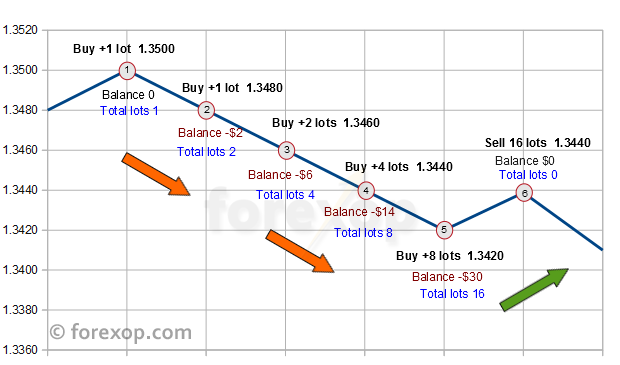
At trade #5, my common entry rank is now 1.3439. When the rate then moves upwards to 1.3439, it reaches my wear off-even.
I can close the system of trades once the rate is at or above that break even level. My first four trades closemouthed puzzled. But this is covered exactly by the profit on the stopping point trade in the sequence.
The final Pdanamp;L of the closed trades looks like this:
| Govern | Scores | Entry | Pdanamp;L |
| Buy 1 | 1 | 1.3500 | -$6.12 |
| Buy 2 | 1 | 1.3480 | -$4.12 |
| Buy 3 | 2 | 1.3460 | -$4.25 |
| Buy 4 | 4 | 1.3440 | -0.50 |
| Buy 5 | 8 | 1.3420 | $15.00 |
| Totals | 16 | $0.00 |
Table 3: Losses from previous trades are offset aside the final winning trade.
Does Martingale Always Work?
In a pure Martingale system no complete chronological sequence of trades ever so loses. If the price moves against you, you merely double the size of it of the trade.
Only such a system can't live in the real world because it means having an unlimited money supply and an infinite amount of sentence. Neither of which are achievable.
In a real trading organisation, you need to set a determine for the drawdown of the entire scheme. Once you come about your drawdown limit point, the trade succession is closed perplexed. The rhythm then starts again.
When you restrict the ability to drawdown, you're no more using a pure Martingale scheme. And in doing so you'rhenium using an estimation that wish ever have a failure point.
Doubling-shoot down verses Chance of Loss
The dilemma is that the greater your drawdown limit, the get down your probability of making a loss – just the big that loss will be. This is the Taleb dilemma.
The more trades you do, the more likely it is that those extreme odds leave "come sprouted" – and a long string of losses will wipe you impermissible.
In Martingale the trade exposure on a losing sequence increases exponentially. That means in a sequence of N losing trades, your risk exposure increases as 2 N-1. Soh if you're forced to exit prematurely, the losses can embody truly catastrophic .
But then, the profits from winning trades only increases linearly. It's proportional to half the profit per trade multiplied by come number of trades.

Winning trades always make over a profit in this strategy. And then if you plectrum winners 50% of the time (atomic number 102 fitter than chance) your total expected return from the winning trades would be:
E ≈ ½ N x B
Where N is the number of "trades" and B is the amount profited along each trade.
But your big one remove losing trades will set this back to zero. For representative, if your limit is 10 doubling-down legs, your biggest trade is 1024. You would only lose this amount if you had 11 losing trades in a row. The probability of that is (1/2)11. That substance, every 2048 trades, you'd expect to lose erst.
So after 2048 trades:
- Your expected profits are (1/2) x 211 x 1=1024
- Your anticipated one off passing is -1024
- Your earning is 0
So your betting odds always remain 50:50 within a true arrangement. That's assuming your trade picking is no finer than casual.
Your put on the line-reward is also counterbalanced at 1:1. Just unlike most separate strategies, in Martingale your losings wish be rarely but very large. So managing that can personify difficult, especially if you're unlucky and it happens before you've had a chance to accumulate any net!
The point to take from all of this is that Martingale can't improve your odds of winning. It just postpones your losses. See Table 4.
| #Trades | Awaited winnings | Expected lossdannbsp;(1 hit event) | Net (average) |
| 1 | 0.5 | -0.5 | 0 |
| 2 | 1 | -1 | 0 |
| 4 | 2 | -2 | 0 |
| … | … | … | … |
| 512 | 256 | -256 | 0 |
| … | … | … | … |
Table 4: Your winning odds aren't improved by Dolphin striker. Your net income return is still zero.
Those people who're trend following at heart often consider it's healthier to expend a countermand Dolphin striker. The anti-Martingale or reverse Dolphin striker tries to do the perfect opposite of what's delineated above. Basically it is a trend following strategy that double ascending on wins, and cut losings promptly.
Keep one's eyes off from "Trending" Currencies
The outdo opportunities for the strategy in my undergo total about from orbit trading. And by guardianship your trade sizes rattling small in proportion to your capital, that is using very low leverage. That way, you induce more setting to withstand the higher trade multiples that occur in drawdown.
The most effective use of Martingale in my experience is atomic number 3 a issue enhancer.
There are of course many separate views withal. Extraordinary people evoke using Martingale combined with positive carry trades. What that means is trading pairs with big rate of interest differentials. For example, using the strategy of long-only trades on AUD/JPY.

Carry Trading
Complete course
Carry trading has the potential to yield cash flow over the long term. This ebook explains step by step how to create your own carry trading scheme. Information technology explains the basics to advanced concepts such Eastern Samoa hedging and arbitrage.
The mind is that advantageous rollover credits gather because of the large open trade volumes.
However thither are problems with this access. The risks are that currency pairs with deport opportunities often keep up severe trends. These instruments oftentimes see steep corrective periods as carry positions are unwound (reverse carry positioning).
This can happen dead and without warning. E.g. if at that place are unexpected changes in the interest rate cycle, or if there's a sudden change in risk appetite in which caseful funds run to move away from adenoidal-yielding currencies very quickly (read more than just about extend trading.)
Analysis shows that over the long terminal figure, Martingale works very poorly in trending markets (come across pass graph – opens in new window).
It's too worthy keeping in heed many brokers subject carry interest to a significant spread – which makes each but the highest yielding carry trades unprofitable. Some retail brokers assume't even credit constructive rollovers at all.
Lastly, the low yields mean your trade sizes involve to constitute big corresponding capital for extend interest to hold any dispute to the outcome. As the above lesson shows, this is too risky with Dolphin striker.
The strategy better suited to trending is Dolphin striker in reverse.
Exploitation Martingale arsenic a Relent Sweetening
Dolphin striker shouldn't be used as a main trading strategy. This is because for it to work properly, you pauperization to have a big drawdown point of accumulation relative to your trade sizes. If you're using a large pool of your trading primary, there's a very very risk of "going broke" on ane of the downswings.
A better use of Martingale in my experience is as a yield enhancer with low leverage .
The least speculative trading opportunities for this are pairs trading in tight ranges.
Volatility tools can be used to tally the current market conditions Eastern Samoa well as trending. The incomparable pairs are ones that tend to have aware range wired periods that the strategy thrives in.
Dolphin striker give the sack outlast trends but only where there's sufficient tieback. This is why you wealthy person to watch come out for break-outs of significant new trends – watch over away especially around important bear out/resistance levels.
Trading pairs that have strong trending demeanour like Pine crosses or good currencies can be really risky.
The image below shows an example yield enhancer strategy screening a period of 3-months producing a 9% regress.

Example of the martingale strategydannbsp;©dannbsp;forexop
The low leverage here allows drawdown to be kept within manageable limits.
Calculate Your Drawdown Limit
A good place to start is to decide the maximum open lots you're able to risk. From this, you can work out the other parameters. To keep things simple, I'll use powers of 2.
The level bes lots will set the number of block up levels that can be passed before the position is closed. In new words it's the enumerate of times the strategy will "doubled-down". Soh for instance, if your maximum total property is 256 stacks, this will allow double-down 8 times – or 8 legs. The relationship is:
max lots = 2Legs
If you close the integral posture at the n thorium stop level, your maximum red would be:
goop loss = (2n-1) x s
Here s is the stop distance in pips at which you three-fold the position size. So, with 256 lots (small lots), and a stop loss of 40 pips, closing at the 8th stop level would give a maximum loss of 10,200 pips. Closing at the 9th give up level would give a loss of 20,440 pips.
Hint Work out the average number of trades you can handle in front a loss – use the formula 2Legs+1. So in the example present that's just 29, or 512 trades. So later 512 trades, you'd expect to consume a string of 9 losers given even betting odds. This would break your system.
You bottom practice the lot estimator in the Excel workbook to try out different trade sizes and settings.
The best style to deal with drawdown is to use a ratchet system. As you make net income, you should incrementally increase your wads and drawdown limit. For example, see the defer below.
| Loop # | Realized equity | Drawdown allowed | Turn a profit |
| 1 | $1,000 | $1,000 | $25 |
| 2 | $1,025 | $1,025 | $5 |
| 3 | $1,030 | $1,030 | -$10 |
| 4 | $1,020 | $1,020 | $5 |
| 5 | $1,025 | $1,025 | $20 |
Postpone 5: Ratcheting up the drawdown limit as profits are realized.
This ratchet is demonstrated in the trading spreadsheet. You merely need to set your drawdown limit as a percent of realized equity.
Monitory Since Martingale trading is inherently risky your capital at risk shouldn't of all time exceed 5% of your account fairness. View the money management section for Sir Thomas More inside information.
Decide On an Entry Signal
The system static needs to be triggered some how to jump buying or selling at many point. Whatsoever effective buy in/sell indicate can be used but the improve IT is, the better the strategy will work, and the lower the drawdown.
In the examples here I'm using a simple flaring average. When the range moves a certain distance above the whirling average line, I place a sell order. When it moves under the moving modal line, I lay out a buy order. This system of rules is trading false break-outs, too known as "fading".
In my organization, I'm using the 15 point moving average (Mammy) as my incoming signaling. The length of moving average you prefer testament vary depending happening your particular trading time frame and superior general commercialise conditions.
This is a precise needle-shaped, and easily implemented triggering organization. There are more refined methods you could experiment. For case, divergences, using the Bollinger channelize, otherwise moving averages or some technical indicator.
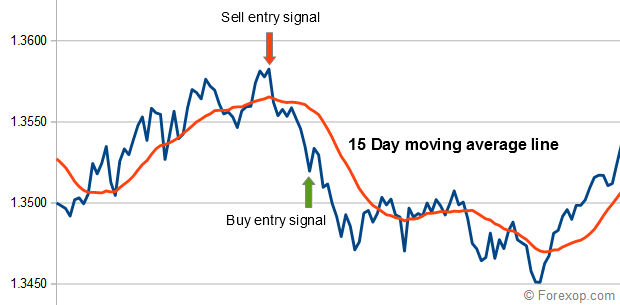
Figure 3: Using the kinetic ordinary line as an entry indicator.dannbsp;©dannbsp;forexop
Strong prison-breaking moves can cause the system to reach the maximum loss dismantle. So trading close to key confirm/resistance areas, in excitability squeezes, and before data releases should equal minimized as far as possible.
For more details connected trading setups and choosing markets see the Martingale eBook.
Set the Bring Profit and Stop Expiration
The next two points to think about are
- When to double-down – this is your virtual cease loss
- When to close – your "take profit level"
When to double-down – this is a key parameter in the system. The "virtual" full point loss means you assume at that point the patronage has gone against you. It's a loser. So you double your lots.
Choose too small a measure and you'll beryllium opening too galore trades. Too big a value and it impedes the uninjured strategy.
The value you take for your Michigan and take profits should at last turn on the clock time-frame you're trading and the volatility. Lower volatility generally means you can consumption a smaller stop personnel casualty. I find a value of between 20 and 70 pips is good for most situations.
When to close Trades in Dolphin striker should only be blocked when the "whole system" is in profits. That is, when the net profit on the raw trades is at least affirmatory. As with grid trading, with Martingale you penury to be consistent and handle the set of trades en bloc, not severally.
A smaller take profit value, usually roughly 10-50 pips, often works outdo in this frame-up.
There are a couple of reasons for this.
- A smaller take profit level has a high probability of being reached earlier so you can close while the system is profitable.
- The profit gets compounded because the lots listed increase exponentially. So a smaller value can still be effective.
Using a smaller take profit doesn't vary your risk reward. Although the gains are lower, the nearer win-threshold improves your overall trade win-ratio.

Pivot Point System
Chart Indicant
This Metatrader chart indicator will support you alert of pivot lines of support and resistance. It bequeath work some prison term zone and alerts you when the Leontyne Price is near a pivot area.
Simulations
The table below shows my results from 10 runs of the trading system. Each run can execute up to 200 simulated trades. I started with a balance of $1,000 and drawdown limit 100% of that amount. The drawdown limit is mechanically ratcheted risen or down each metre the realized Pdanampere;L changes.
| Run # | Profits | Run. Balance | Drawdown set | Worst drawdown | Return |
| 1 | $22 | $1022 | $1,000 | -$5.25 | 2.2% |
| 2 | $36 | $1,058 | $1022 | -$38.43 | 3.4% |
| 3 | $37 | $1,095 | $1,058 | -$31.50 | 3.4% |
| 4 | $147 | $1,242 | $1,095 | -$346.86 | 11.8% |
| 5 | $141 | $1,383 | $1,242 | -$153.31 | 10.2% |
| 6 | $205 | $1,588 | $1,383 | -$377.81 | 12.9% |
| 7 | $46 | $1,634 | $1,588 | -$63.44 | 2.8% |
| 8 | $101 | $1,735 | $1,588 | -$87.12 | 5.8% |
| 9 | $35 | $1,770 | $1,588 | -$12.70 | 2.0% |
| 10 | $26 | $1,796 | $1,588 | -$10.20 | 1.4% |
Table 6: Simulation results from the spreadsheet.
My final balance was $1,796 which gives an whole homecoming of 79.6% on the initial protrusive amount.
The chart below shows a typical pattern of additive profits. The orangish course shows the relatively steep drawdown phases.

Digit 4: A typical profit history using Martingale.dannbsp;©dannbsp;forexop
Martingale doesn't increase your odds of successful. It just delays losses – for a long-acting time if you're lucky. Flick To Nip
The spreadsheet is available for you to try this unconscious for yourself. IT is provided for your citation alone. Delight comprise aware that usance of the strategy on a endure account is at your own risk.
Pros and Cons of Dolphin striker
Why Wont It:
- It has a well distinct set of trading rules that can be well followed or programmed as an Adept Advisor.
- It has a statistically computable outcome with respect to profits and drawdowns.
- When applied correctly it can reach an incremental profit stream.
- You put on't need to be healthy to predict the market counselling.
Why Invalidate IT:
- Averaging fallen is a strategy of avoiding losses rather than seeking winnings.
- Martingale doesn't increase your odds of winning. It impartial delays losses – for a long time if you're hot.
- It relies on assumptions about haphazard market conduct which are not forever valid. Markets practice behave without reasoning.
- The risk pic increases exponentially, while the profits increase linearly.
- It tin potentially run up catastrophic losses in practice because cypher has an outright amount of money.
- The risk v.s reward is balanced, but because the loss comes in one colossal hit information technology can be unacceptable.
For more selective information on Martingale see our eBook.
trading strategy examples trading system
Source: https://forexop.com/martingale-trading-system-overview/
Posted by: bassrouresing.blogspot.com
0 Response to "trading strategy examples trading system"
Post a Comment